
Tesla Model Y: Complete Guide to Features, Range, Technology, Pricing, and Key Facts
Context: Understanding the Tesla Model Y and the Rise of Electric Vehicles
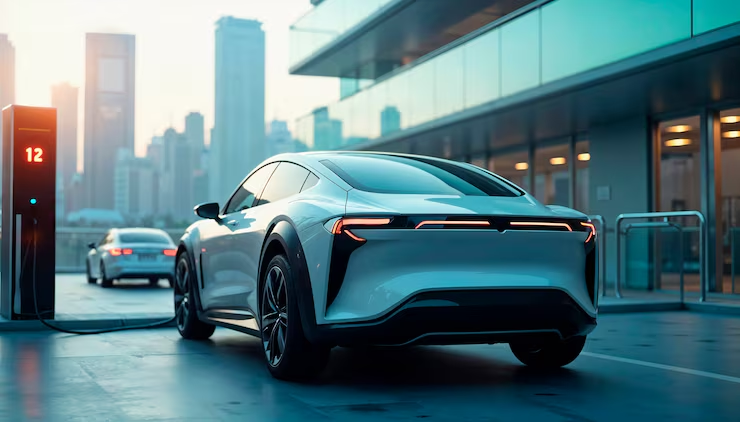
The Tesla Model Y is an all-electric compact sport utility vehicle developed by Tesla, Inc.. It was introduced to expand the company’s electric vehicle lineup and provide a practical option for families and daily commuters. The vehicle shares engineering architecture with the Tesla Model 3 but uses a larger body design, offering additional passenger and cargo space.
Electric vehicles (EVs) have grown rapidly in popularity due to increasing attention on climate change, fuel efficiency, and technological innovation. Unlike traditional internal combustion vehicles that rely on gasoline engines, the Model Y uses a lithium-ion battery pack and electric motors for propulsion. This allows the vehicle to operate with zero tailpipe emissions.
Several core aspects define the Model Y’s design and functionality:
-
Long-range battery technology
-
Advanced driver-assistance software
-
Integrated digital interface and connectivity
-
Over-the-air software updates
-
Access to a large charging infrastructure network
These features position the Model Y within the broader electric mobility ecosystem, where battery efficiency, autonomous driving research, and energy sustainability are major areas of technological development.
A simplified comparison of electric vehicle architecture helps explain the difference between EVs and conventional vehicles.
| Vehicle System | Electric Vehicle (Model Y) | Traditional Gasoline Vehicle |
|---|---|---|
| Power Source | Lithium-ion battery pack | Internal combustion engine |
| Energy Input | Electricity | Gasoline or diesel |
| Transmission | Single-speed electric drivetrain | Multi-gear transmission |
| Emissions | Zero tailpipe emissions | Carbon dioxide and pollutants |
| Software Integration | Extensive digital software control | Limited software integration |
This technological framework explains why the Model Y is often discussed in relation to energy innovation, autonomous driving research, and next-generation transportation systems.
Importance: Why Electric SUVs Like Tesla Model Y Matter Today
Electric mobility has become an important topic in transportation policy, environmental science, and automotive engineering. Vehicles like the Model Y demonstrate how electric technology can be integrated into widely used vehicle categories such as compact SUVs.
Several factors explain why the topic receives significant attention today.
Growing interest in sustainable transportation
Transportation is one of the largest sources of global carbon emissions. Electric vehicles help reduce greenhouse gas emissions when powered by renewable energy sources. Governments, researchers, and environmental organizations often highlight EV adoption as part of broader climate strategies.
Advances in battery technology
Modern EVs rely on high-capacity lithium-ion batteries that allow longer driving distances on a single charge. Improvements in battery density, thermal management, and charging speed have significantly increased practical usability. Like us:-Elon Musk Life Story Explained Career, Net Worth, Business Strategy & Innovation Insights
Expansion of charging infrastructure
The growth of public charging networks, including the Tesla Supercharger Network, has helped address concerns about long-distance travel. Charging networks are increasingly installed in urban centers, highways, and commercial areas.
Digital vehicle ecosystems
Vehicles like the Model Y integrate advanced computing systems, cloud connectivity, and driver-assistance algorithms. Software updates can improve vehicle functionality over time without requiring physical modifications.
Consumer demand for crossover SUVs
Compact crossover SUVs are one of the most popular vehicle segments globally. The Model Y adapts electric technology to this widely used vehicle format, making EV adoption more accessible to a broader audience.
The following simplified chart illustrates the growing global trend in EV adoption.
EV Adoption Trend (Global Passenger Vehicles)
Year EV Share of Global Car Sales
2019 ███
2020 █████
2021 ███████
2022 ███████████
2023 ███████████████
2024 ██████████████████ (estimated)
This growth trend demonstrates how vehicles like the Model Y contribute to broader transportation transitions toward electric mobility.
Recent Updates: Developments and Trends in the Past Year
During 2024 and early 2025, several developments influenced the discussion around the Model Y and the broader EV market.
Global sales leadership
According to industry reports in early 2024, the Model Y became one of the highest-selling passenger vehicles globally during 2023. This milestone reflected strong demand for electric SUVs in multiple regions.
Software updates and driver-assistance improvements
Tesla Autopilot and the optional Tesla Full Self‑Driving (FSD) software continued to receive incremental updates through over-the-air updates throughout 2024. These updates included enhancements to navigation, lane-keeping assistance, and traffic-aware cruise control.
Manufacturing improvements
Production efficiency has improved through manufacturing facilities such as:
-
Gigafactory Texas
-
Gigafactory Berlin‑Brandenburg
-
Gigafactory Shanghai
These facilities use advanced manufacturing techniques such as large casting components and integrated battery pack designs.
Battery innovation research
The company continues research on higher-capacity battery formats and improved charging efficiency. Industry discussions frequently mention the potential role of the 4680 Battery Cell, which aims to improve energy density and simplify manufacturing.
Charging infrastructure expansion
The Tesla Supercharger network expanded significantly throughout 2024, and several governments announced plans to integrate standardized charging systems across brands.
Laws or Policies Affecting Electric Vehicles
Electric vehicle adoption is influenced by a variety of policies, environmental regulations, and national transportation strategies.
Emissions regulations
Many countries have introduced stricter emissions standards to reduce pollution from internal combustion engines. Electric vehicles help manufacturers comply with these regulations.
Government incentives and tax credits
Some governments provide incentives for EV adoption. In the United States, the Inflation Reduction Act introduced tax credits for certain electric vehicles and battery supply chains.
India’s EV policy framework
In India, electric vehicle adoption is supported through programs such as the FAME India Scheme. This program encourages EV manufacturing, charging infrastructure development, and adoption through financial incentives.
Charging infrastructure regulations
Many countries are implementing standards to ensure interoperability between charging networks, connectors, and energy providers.
Safety regulations
Electric vehicles must comply with automotive safety standards established by regulatory bodies in each country. Safety evaluations often include crash testing, battery safety assessments, and electronic system reliability.
These regulatory frameworks play a significant role in shaping how electric vehicles are produced, marketed, and integrated into transportation systems.
Tools and Resources for Understanding Electric Vehicles
Several digital tools and resources help individuals research EV technology, battery efficiency, and charging infrastructure.
Electric vehicle range calculators
Online EV range calculators estimate driving distance based on factors such as speed, weather conditions, terrain, and battery capacity.
Charging station locator apps
-
PlugShare
-
ChargePoint
These applications help drivers locate nearby charging stations and view availability in real time.
Energy consumption monitoring tools
EV dashboards and companion apps display energy consumption, charging statistics, and battery health data.
Vehicle comparison platforms
-
InsideEVs
-
Electrek
These websites provide technical analysis, industry updates, and performance comparisons across EV models.
Charging time estimation tools
Online calculators estimate how long charging may take depending on charger type, battery size, and charging power.
These resources help users understand electric mobility technology, infrastructure availability, and battery performance metrics.
Frequently Asked Questions
What type of battery does the Tesla Model Y use?
The Model Y uses lithium-ion battery technology. Some versions incorporate advanced battery designs intended to improve energy density, durability, and thermal performance.
How far can the Tesla Model Y travel on a single charge?
Driving range varies by configuration and driving conditions. Long-range versions can exceed 500 kilometers under standardized testing cycles.
What charging methods are available for the Model Y?
Charging options include home wall chargers, public AC charging stations, and high-speed DC charging through networks such as the Tesla Supercharger system.
Does the Model Y support autonomous driving?
The vehicle includes advanced driver-assistance features such as lane-keeping, adaptive cruise control, and traffic-aware navigation through Autopilot software. These features still require active driver supervision.
How often does Tesla update vehicle software?
Tesla vehicles receive over-the-air software updates periodically. These updates can add new features, improve performance, and refine driver-assistance systems.
Conclusion
The Tesla Model Y represents a significant development in modern electric transportation. By combining electric propulsion, software integration, and SUV practicality, the vehicle reflects broader trends shaping the automotive industry.
Electric vehicles continue to evolve through improvements in battery technology, charging infrastructure, and digital vehicle ecosystems. Regulatory frameworks, environmental policies, and technological research all contribute to this transformation.
As the transition toward electric mobility progresses, vehicles such as the Model Y provide insight into how future transportation systems may integrate renewable energy, intelligent software, and advanced engineering to reduce emissions and improve efficiency.
Folllow us:-https://shorturl.at/xFKne
One thought on “Tesla Model Y: Complete Guide to Features, Range, Technology, Pricing, and Key Facts”
Comments are closed.